OpenCode vs Ollama: What Each Tool Does and Which One to Choose
OpenCode is the coding-agent workflow; Ollama is the local model runtime. Compare the layers first, then decide whether you need one, the other, or both.

In this comparison
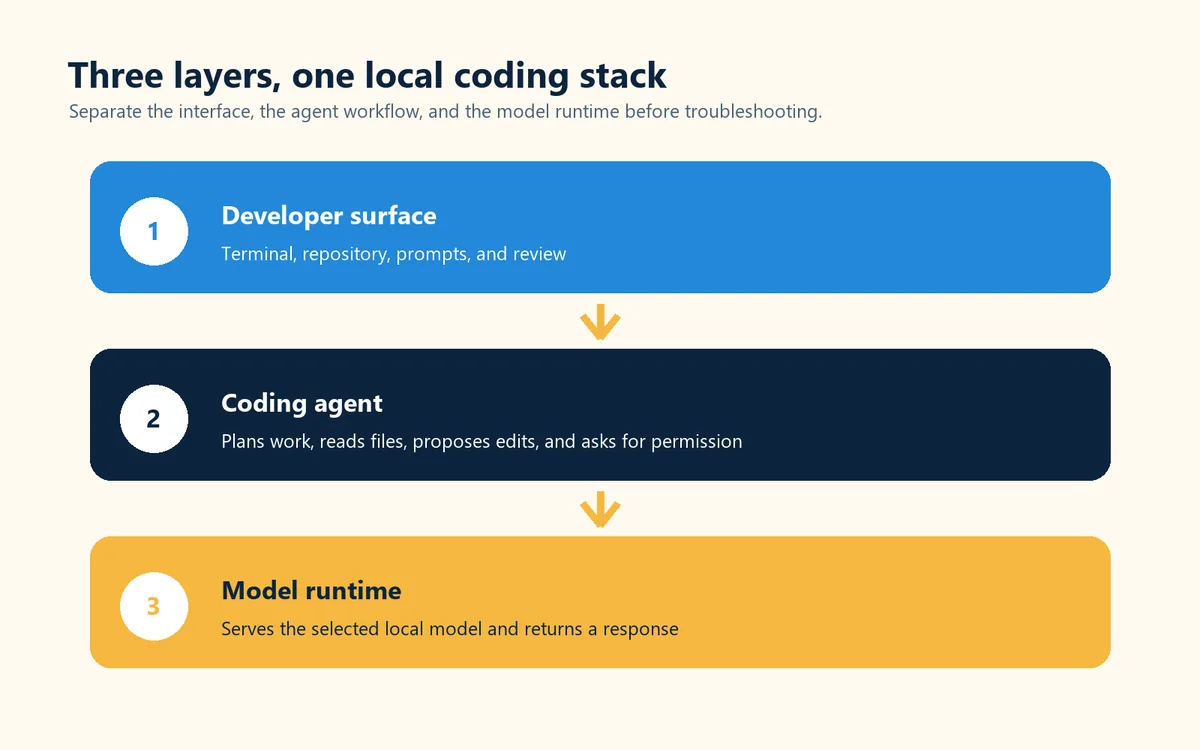
Searching for OpenCode vs Ollama usually means you are deciding how to run a local coding workflow, not comparing two versions of the same product. OpenCode organizes the agent experience around a repository, files, commands, patches, and review. Ollama runs or serves the model that produces a response. Keeping that boundary visible makes the setup easier to choose and troubleshoot.
OpenCode vs Ollama: the short answer
Choose OpenCode when the question is how an AI coding agent should work inside a repository. You are evaluating task planning, file context, tool use, command approval, and patch review. OpenCode remains useful even when the underlying model provider changes.
Choose Ollama when the question is where a model should run. Ollama manages local model execution and exposes an endpoint that a client can call. Choose both when you want OpenCode to provide the workflow while Ollama provides local inference.
The boundary to remember
OpenCode organizes the coding work. Ollama serves the selected model. A reliable stack keeps both responsibilities observable.
What OpenCode contributes to a local coding workflow
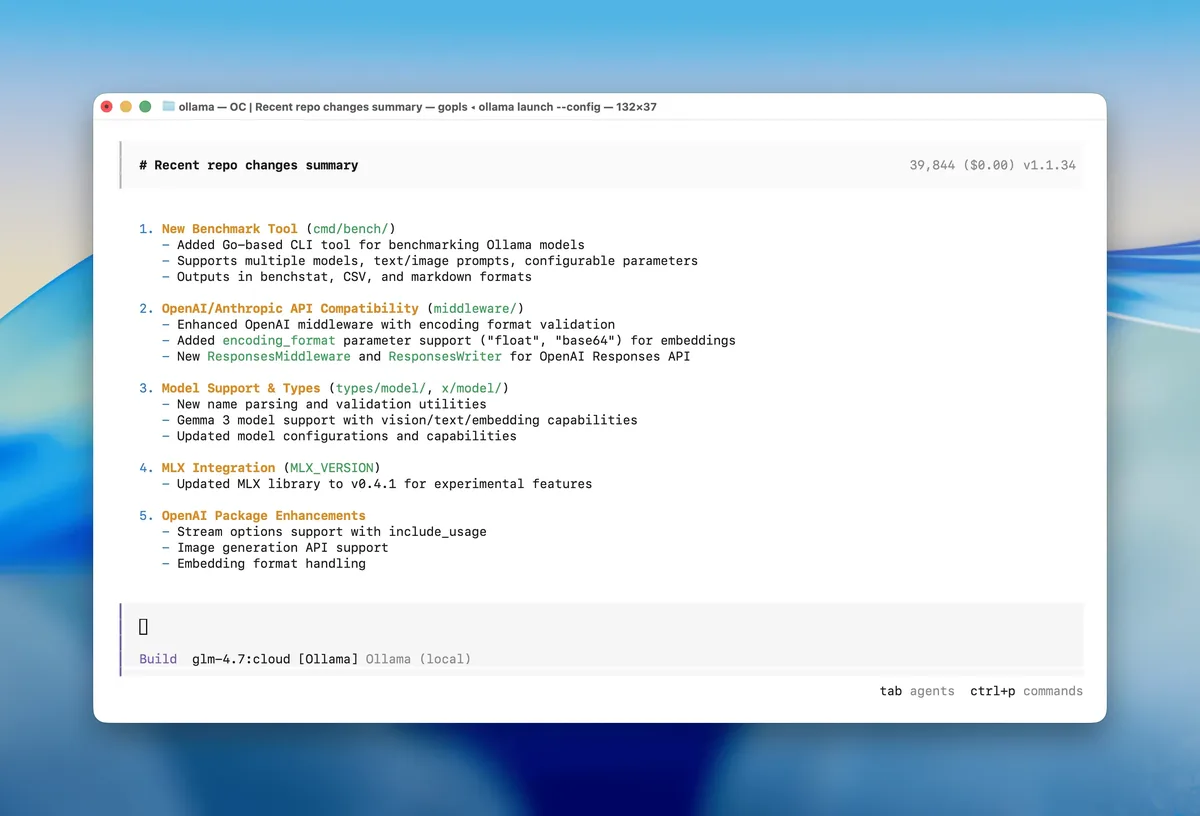
OpenCode is a coding-agent surface around the model. The useful unit is a task loop: select a repository, inspect files, explain a plan, propose a patch, run approved actions, and review the result. That is different from sending a free-form prompt to a model endpoint.
The workflow also needs boundaries. Decide which directory is in scope, which files are sensitive, whether the agent may write, and which commands require approval. If a path or permission is wrong, changing the model runtime may not solve the real problem.
| OpenCode responsibility | Practical meaning | Does not prove |
|---|---|---|
| Repository context | Keep the request anchored to selected files. | That every file should be sent to the model. |
| Agent loop | Plan, inspect, propose, execute, and summarize. | That every command is automatically safe. |
| Provider choice | Use a compatible local or remote model service. | That the endpoint or model tag is reachable. |
What Ollama contributes: the local model runtime
Ollama makes local model execution practical for another application. It can manage model artifacts, start a model, and expose an endpoint. In a coding workflow, that endpoint is where OpenCode sends a prompt and receives a model response.
The runtime has its own limits: model size, quantization, context length, GPU or CPU offload, available memory, and concurrent services. A model can be installed yet still be a poor daily choice if it swaps heavily or leaves no headroom for the editor, repository tools, and tests.
| Ollama responsibility | Useful outcome | Separate decision |
|---|---|---|
| Serve a model | A client receives local inference. | Whether the model fits the coding task. |
| Expose an endpoint | OpenCode has a provider URL. | Whether that URL is reachable from the caller. |
| Manage resources | Test model and context choices. | Whether the whole machine has enough memory. |
OpenCode vs Ollama comparison table
Compare the layers rather than counting features. If the failure is in the OpenCode column, changing models may not help. If it is in the Ollama column, editing agent instructions will not fix a missing model or unreachable endpoint.
| Decision area | OpenCode | Ollama |
|---|---|---|
| Primary role | Coding-agent interface and repository workflow. | Local model runtime and API service. |
| Main input | Task request plus repository context. | Prompt, model tag, and request options. |
| Processing | Plans work, reads files, and calls approved tools. | Loads a model and runs inference. |
| Main output | Plan, patch, command result, or review state. | Generated response or API payload. |
| Typical failure | Scope, permission, tool, or patch assumption. | Model, URL, process, memory, or binding. |
| Best first test | Read one small file and propose a change. | Send one small prompt to one installed model. |
When should you choose OpenCode, Ollama, or both?
Choose OpenCode alone when the provider is already available and you are evaluating repository-aware agent behavior. Choose Ollama alone when you need a local endpoint, a model test bed, or a runtime for a trusted client.
Choose both when local inference and a structured coding workflow are both requirements. Start with one model, one provider entry, one repository, and one bounded task. Do not add multiple runtimes, dashboards, plugins, and remote ports at the same time.
A practical default
Prove the runtime, connect the agent, run a read-only task, and review one patch before adding larger context or tools.
- OpenCode: repository context, permissions, tools, patches, and review.
- Ollama: local model serving, endpoint health, model tags, and resources.
- Both: a structured coding agent backed by local inference.
- Another provider or client: when its model, controls, or deployment fit is better.
A safer first OpenCode and Ollama evaluation
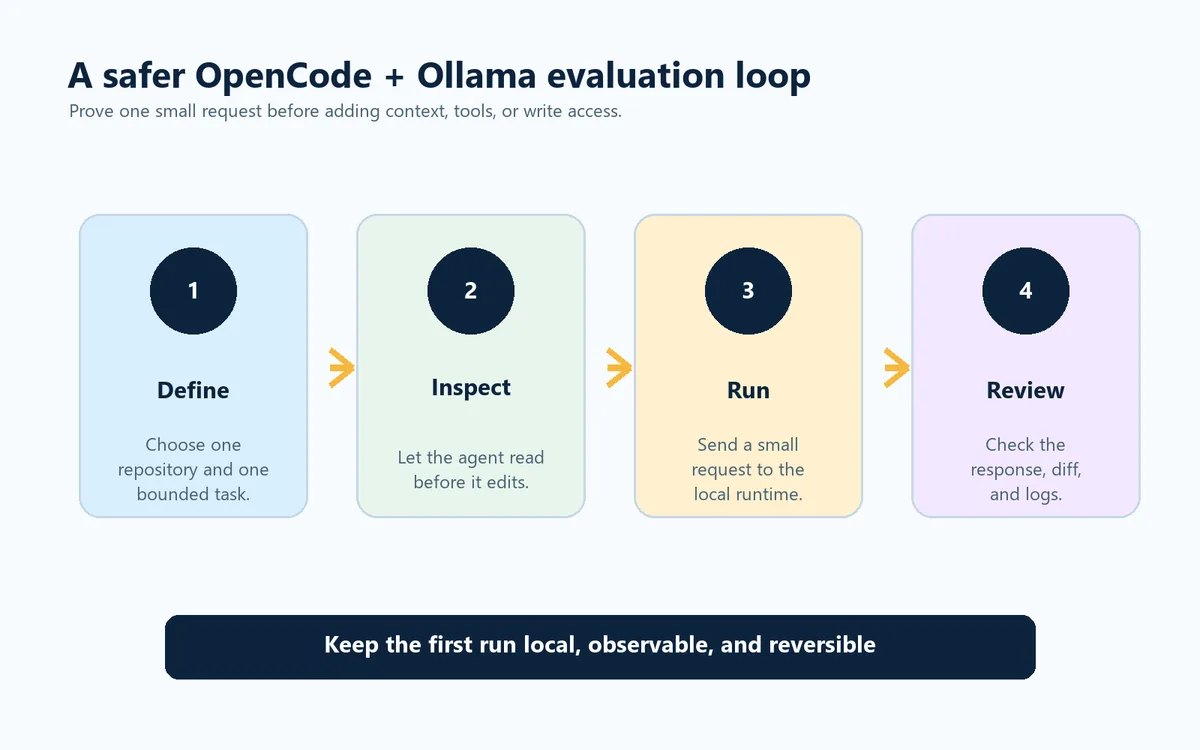
Use a small non-sensitive repository or a copy of one. Decide what success means first: explain one function, locate one test, or propose a minimal documentation edit. A bounded task helps separate model quality from workflow quality.
Start read-only. Ask OpenCode to locate files, explain the plan, and show a patch without applying it. If the response is weak, record whether the cause is the model, context, endpoint, repository size, or agent instruction before changing settings.
-
Define
Choose one repository, one small question, and a clear success condition.
-
Inspect
Ask for relevant files and a plan before allowing a write.
-
Run
Send one small request through the verified Ollama endpoint.
-
Review
Check the answer, diff, tests, and logs before expanding the setup.
Context, hardware, and endpoint boundaries
A larger context window is not automatically a better workflow. Start with the smallest context that contains the needed files and instructions. Budget RAM and GPU memory for the operating system, editor, tests, containers, and background services as well as the model.
Endpoint names depend on deployment. Native processes may reach localhost, while a container may need a host gateway or service name. If a request works in a terminal but fails from OpenCode, test it from the same network namespace as the client.
| Signal | Likely layer | First check |
|---|---|---|
| Missing model tag | Ollama | List models and copy the exact tag. |
| Works in terminal only | Provider/network | Test from the same namespace as OpenCode. |
| Good answer, unsafe patch | Agent workflow | Tighten scope, permissions, and review. |
| Every turn is slow | Resource budget | Reduce context or model size and leave headroom. |
Common mistakes in the OpenCode vs Ollama comparison
Do not treat the two names as competing versions of one product. Map interface, workflow, provider, runtime, model, and infrastructure before comparing a feature. Also do not assume that local means automatically private: logs, backups, plugins, and remote access can still move data.
Finally, change one variable at a time. Record the model tag, endpoint shape, context, task, and diff so the next decision is based on evidence rather than memory.
| Mistake | What goes wrong | Better move |
|---|---|---|
| Comparing names instead of layers | A runtime is judged by agent features. | Separate workflow from model service. |
| Using localhost blindly | A container calls itself instead of the host. | Check the caller's network namespace. |
| Granting write access first | A wrong interpretation changes files early. | Begin read-only and require a patch preview. |
OpenCode vs Ollama FAQ
Official documentation to verify details
- Ollama OpenCode integration - Current launch and connection details.
- OpenCode Ollama provider documentation - Provider configuration and options.
- Ollama API documentation - Local API behavior and request reference.
Related local coding and Ollama guides
- OpenCode Ollama setup guide - Provider, base URL, model tag, context, and connection checks.
- Local AI coding agent workflow - Repository boundaries, permissions, patches, tests, and review.
- Cursor and Ollama coding agent - An editor-first local workflow comparison.
- Best local coding model for 16GB RAM - Model size, context, and memory headroom.
- Ollama vs Odysseus - Runtime versus broader self-hosted workspace.
Last updated: September 17, 2026
Back to Odysseus AI Wiki